
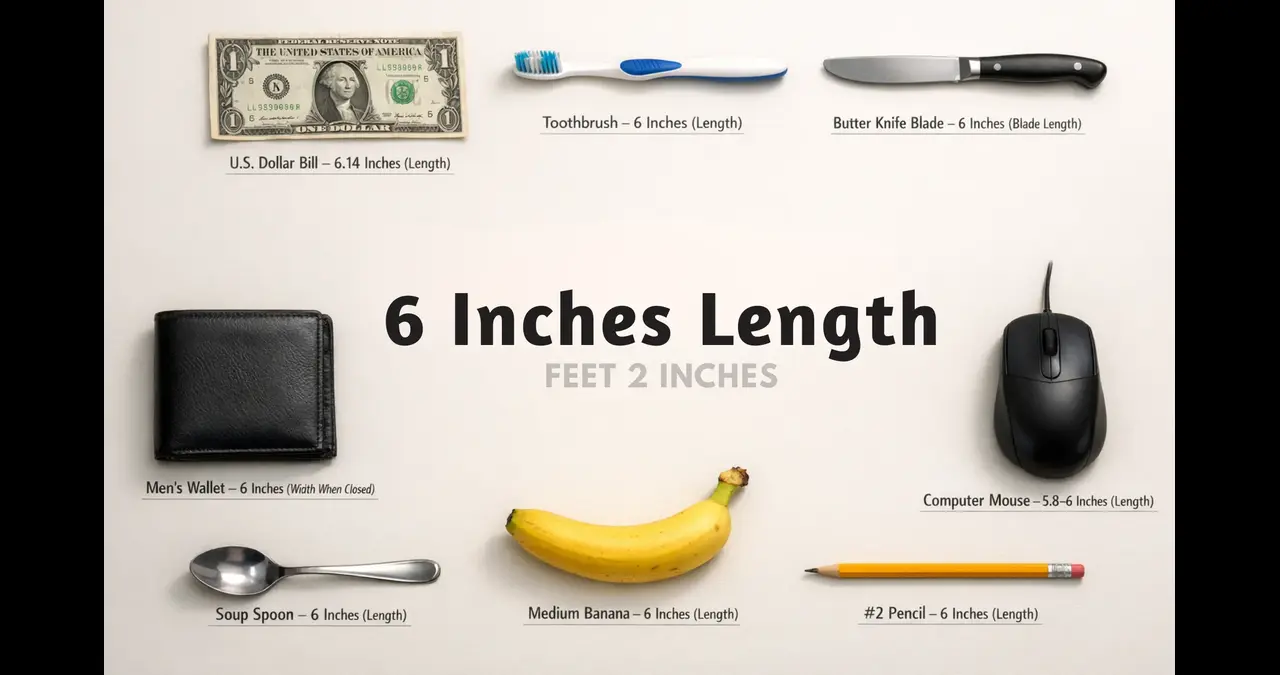

When someone says something is six inches long, it can sound straightforward, but the measurement is surprisingly useful in everyday life. We regularly encounter this length when buying products, comparing objects, checking dimensions, working on crafts, measuring materials, or simply trying to understand the size of something without seeing it in person. Knowing what six inches actually looks and feels like makes measurements much easier to visualize.
The phrase “six inches” describes a specific length in the imperial measurement system. It is commonly used in the United States and in situations where products, tools, clothing, furniture, electronics, and other everyday items are described using inches. While the measurement itself is precise, people often understand it better when it is connected to familiar objects and practical examples.
This guide takes a detailed look at six inches from several angles. Rather than treating it as just a conversion, we will explore how long it is, how to visualize it, how to measure it accurately, how it compares with other common lengths, and where this measurement appears in everyday situations. By the end, six inches should feel like a familiar physical distance rather than an abstract number.
What Does Six Inches Mean?
An inch is a unit used to describe length. Six inches simply means that an object or distance extends across six individual inch-length units placed end to end. It is a relatively short measurement, but it is long enough to be noticeable and useful for describing many everyday objects.
One of the easiest ways to understand six inches is to imagine a standard ruler. On an ordinary ruler marked in inches, the distance from the starting point to the six-inch mark represents exactly six inches. The important thing is to start measuring from the correct zero point rather than from the physical edge of the ruler if that edge is damaged or offset.
Six inches is also equal to half a foot because a foot contains twelve inches. This makes the measurement particularly easy to visualize if you are familiar with feet and inches. Imagine dividing a one-foot ruler into two equal sections. Each section represents six inches.
How Long Is Six Inches in Everyday Terms?
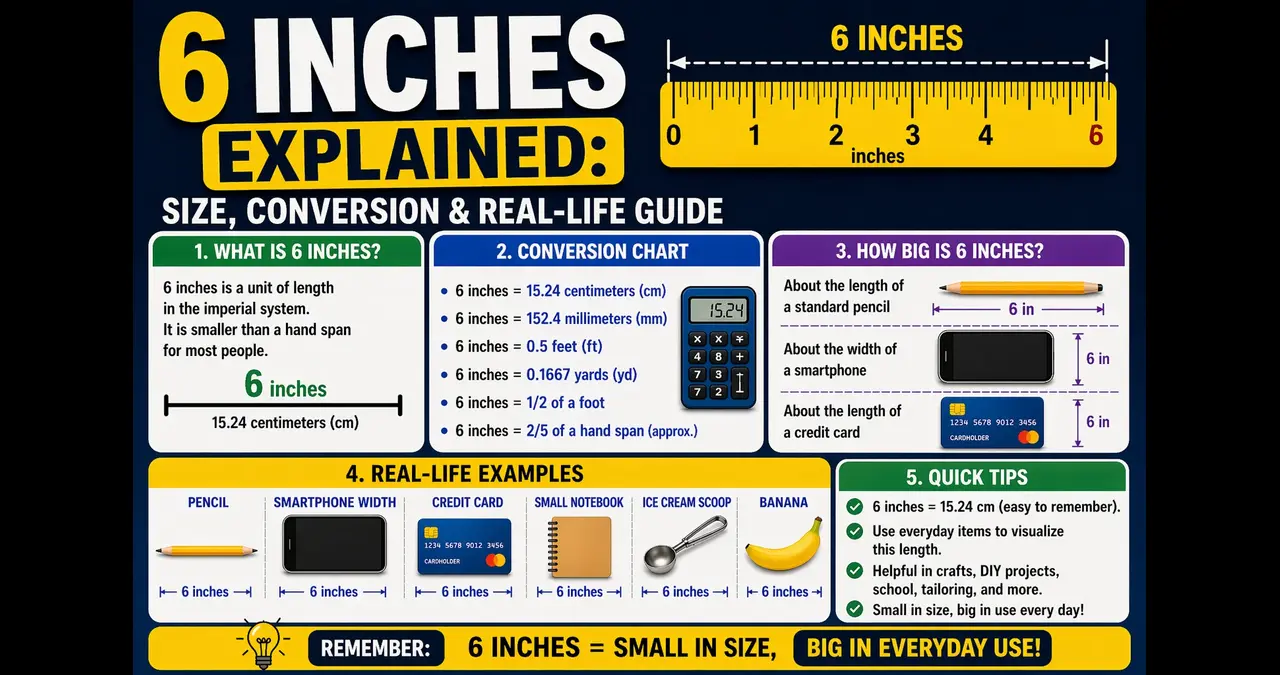
The biggest challenge with measurements is often visualization. If someone tells you that a package, object, or piece of material is six inches long, you may understand the words without immediately picturing the actual size. Familiar objects can make the comparison much easier.
A typical adult hand can provide a rough visual reference, although hand sizes vary considerably from person to person. For some people, the distance across a hand or a portion of the hand may be reasonably close to six inches. It should be treated only as an approximation rather than a precise measuring method.
A standard pencil can also provide a useful comparison, depending on its particular design and whether it is new or shortened through use. Many common pencils are around this general range when measured from end to end, making them a convenient mental reference. However, pencils come in different sizes, so they should not be considered exact measuring instruments.
Six Inches on a Ruler
A ruler is one of the simplest tools for understanding this measurement. On an imperial ruler, the longer markings identify whole inches, while smaller markings divide each inch into fractions. When you locate the six-inch mark, you have reached the exact length represented by six inches.
The ruler should be placed directly alongside the object being measured. Ideally, one end of the object should line up with the ruler’s zero mark. From there, the point where the other end reaches the ruler gives you the object’s length.
It is worth remembering that rulers can have different designs. Some begin with a small physical gap before the zero marking, while others have worn edges or unusual construction. For accurate work, always rely on the printed measurement markings rather than assuming the very edge of the ruler represents zero.
Converting Six Inches Into Centimeters
People who normally use the metric system may find inches less intuitive. In that situation, converting six inches into centimeters can make the measurement much easier to understand. One inch corresponds to a little more than two and a half centimeters, so six inches corresponds to a little over fifteen centimeters.
The exact metric equivalent is approximately fifteen point two four centimeters. This conversion is useful when reading product specifications, following international craft instructions, checking furniture dimensions, or comparing measurements from different countries.
Although the exact conversion is useful when precision matters, a rounded value can be enough for everyday visualization. Thinking of six inches as roughly fifteen centimeters gives you a quick mental reference without requiring a calculator every time.
Why Six Inches Is a Useful Measurement
Six inches sits in a convenient range between very small and relatively large measurements. It is long enough to describe recognizable objects while remaining short enough to measure easily with an ordinary ruler. This makes it particularly common in everyday descriptions.
The measurement also works well for products and materials. Packaging dimensions, stationery, craft supplies, small tools, household accessories, electronic devices, and decorative items can all be described using lengths around this range.
Another reason it is useful is that it divides a foot neatly in half. When someone is comfortable thinking in feet, imagining half of a foot immediately provides a strong visual reference. That relationship makes six inches easier to remember than many less familiar measurements.
Common Objects That Can Help You Visualize Six Inches
If you do not have a ruler nearby, familiar objects can provide approximate comparisons. A small notebook, part of a sheet of paper, a short pencil, or certain kitchen utensils may fall close to this length. The exact dimensions vary, so these comparisons are useful for visualization rather than precision.
Your smartphone can also be a helpful reference, although phone dimensions differ significantly between models. Some phones have a body length close to this range, while others are considerably longer or shorter. If you know your own phone’s dimensions, it can become a surprisingly convenient personal reference.
A typical adult hand can offer another rough comparison. Placing your hand next to a ruler once can help you discover how your own proportions compare with six inches. This is more useful than assuming everyone has the same hand size.
Six Inches Compared With a Foot
The relationship between six inches and a foot is extremely simple. Six inches represents half of a foot. If a foot were divided into two equal parts, each part would measure six inches.
This relationship is helpful in construction, home improvement, woodworking, and other practical situations. Someone might say that a material needs to be cut to half a foot, and that can immediately be understood as six inches.
Thinking in halves can also make mental estimation easier. If you know what one foot looks like, mentally dividing that distance in half gives you a practical approximation of six inches. It is not a replacement for a measuring tool, but it is an excellent way to develop measurement awareness.
Six Inches Compared With Smaller Measurements
Six inches is much larger than a single inch, but it is still considered a relatively short length. This makes it useful for objects that are too large to describe conveniently in tiny units but too small to require feet or yards.
For example, a small craft project might involve a strip of material measuring six inches. A woodworking project might call for a short piece of trim around this length. A school assignment might ask students to draw a line of a particular length. In all of these cases, the measurement provides enough detail to make the instruction meaningful.
The relationship between inches and smaller fractions is also important. An inch can be divided into halves, quarters, eighths, sixteenths, and other fractions depending on the ruler and application. This allows six inches to be measured with considerable precision when necessary.
Six Inches in Crafting and DIY Projects
Crafting is one area where measurements around six inches appear frequently. People working with paper, fabric, cardboard, wood, foam, string, or other materials often need relatively short lengths. A six-inch measurement is manageable, easy to mark, and simple to check.
When making a cut, accuracy matters because even a small difference can affect how separate pieces fit together. A ruler should therefore be used instead of estimating with a hand or another object. This becomes particularly important when multiple pieces need to be identical.
For beginners, practicing with a six-inch line can be a useful introduction to measuring. Draw the line using a ruler, then compare it with an independently measured piece of material. Repeating this process helps develop a better sense of physical distance.
Six Inches in School and Education
Measurements are introduced early in mathematics and science education. Six inches can be especially useful because it provides a practical bridge between abstract arithmetic and physical objects. Students can measure pencils, books, desks, paper, or classroom materials to understand how units work.
Learning measurement is not simply about memorizing conversions. Students need to understand that a unit represents a physical distance. Measuring an actual object helps connect the written measurement with something tangible.
A six-inch line can also be useful for teaching fractions. Since six inches contains several smaller fractional sections, a ruler can demonstrate how a whole measurement is divided into increasingly precise parts. This makes the concept of fractions more concrete.
Measuring Six Inches Accurately
The easiest method is to use a ruler or measuring tape that clearly displays inch markings. Place the starting edge of the object at zero and extend the measuring tool along its length. Read the mark where the object ends.
Avoid holding the measuring tool at an angle. Even a small angle can produce an inaccurate reading because the ruler is no longer measuring the shortest straight distance between the object’s ends.
For flexible materials, keep the material reasonably straight without stretching it unless the instructions specifically require stretching. Fabric, string, and flexible plastic can change length when pulled, so the measuring method should match the purpose of the project.
Why Starting at Zero Matters
One of the most common measurement mistakes is starting from the physical edge of a ruler instead of its zero marking. Some rulers have a small border before the actual measurement scale begins. If you place the object at that border and then read the six-inch mark, the resulting measurement may be wrong.
The solution is simple: find the zero mark first. Align one end of the object with that point and then read the other end. This small habit makes a significant difference in measurement accuracy.
If the zero edge of a ruler is damaged, you can measure from another known mark and subtract the starting position. This method takes a little more attention but can still produce an accurate result when the ruler itself remains properly marked.
Six Inches and Product Dimensions
Online shopping has made understanding dimensions more important than ever. Product listings often provide measurements without showing the physical item next to something familiar. A shopper may see a length of six inches and wonder whether the product is tiny, medium-sized, or relatively large.
The answer depends on what type of product is being described. Six inches can feel quite substantial for a decorative object but relatively small for furniture or a storage container. Measurements always need context.
When shopping online, it helps to visualize the listed dimension before ordering. If possible, use a ruler to mark the measurement on paper or place a strip of tape on a table to represent the length. This can prevent the common mistake of assuming an item will be larger or smaller than it actually is.
Six Inches in Packaging
Packaging frequently uses measurements to describe boxes, containers, envelopes, cases, and accessories. A package with a six-inch dimension may be compact, but its overall size depends on its other dimensions.
For example, a box can have a six-inch length while being much wider or taller. This is why reading all listed dimensions is important. Looking at only one measurement can create a misleading impression of the item’s total size.
Packaging measurements can also affect shipping. The dimensions of a package influence how it fits into storage areas, shipping containers, shelves, and delivery systems. Understanding individual measurements helps businesses and consumers make better decisions.
Six Inches in Home Improvement
Home improvement projects regularly involve inch measurements. Short lengths can appear when installing shelves, adding trim, positioning brackets, cutting boards, or arranging fixtures.
A six-inch distance may seem insignificant, but small measurement errors can become noticeable when several pieces are installed together. If one component is slightly too long or too short, the overall alignment may look uneven.
For DIY work, a tape measure is generally more practical than a short ruler when working with larger materials. However, the basic principle remains the same: establish a clear starting point, keep the measuring tool aligned, and read the marking carefully.
Six Inches in Woodworking
Woodworking requires especially careful measurement because materials often need to fit together precisely. A six-inch cut might be part of a larger structure, a decorative detail, a support piece, or a prototype.
Before cutting, woodworkers often measure and mark the material rather than relying on memory. The old principle of measuring carefully before making an irreversible cut is particularly important when working with expensive or limited materials.
The width of a saw blade can also matter in precision projects. If a piece needs to finish at an exact length, the cutting process should account for material removed by the blade. The measurement written on the project plan is not always the same as the amount of material that should initially be marked.
Six Inches in Fashion and Clothing
Clothing and accessories can also involve inch measurements. Designers and manufacturers may use inches when describing straps, hems, cuffs, pockets, belts, or other components.
Because clothing is flexible and often curved, measuring it requires more care than measuring a rigid object. You may need to lay the garment flat and measure along a specific seam or edge rather than simply stretching it.
This is especially relevant when buying clothing online. Product measurements can sometimes differ from the body measurements used for sizing. Understanding the distinction helps shoppers interpret size charts more accurately.
Six Inches in Technology
Technology products frequently list dimensions in inches. Phones, tablets, displays, cases, accessories, and components can all have measurements that fall around this range.
One important detail is that product dimensions and screen sizes are not necessarily measured in the same way. A screen’s advertised diagonal measurement describes the distance from one corner of the display to the opposite corner, not the width or height of the device.
That distinction matters because a display described as approximately six inches does not mean the device itself is six inches wide or six inches tall. Understanding how a measurement is taken prevents confusion when comparing products.
Six Inches Versus Six-Inch Diagonal
The phrase “six inches” can describe a straight physical length, but it can also appear as part of a diagonal measurement. This is particularly common with screens.
When a screen is described by its diagonal size, the measurement runs from one corner to the opposite corner. The actual width and height are smaller than the diagonal measurement. The exact proportions depend on the screen’s aspect ratio.
This is why two devices with the same diagonal screen measurement can have slightly different widths and heights. The diagonal tells you one specific dimension, not the complete physical shape of the device.
Six Inches in Cooking and Kitchen Measurements
In kitchens, inch measurements can appear in cookware dimensions, baking pans, cutting boards, knives, storage containers, and serving equipment. A six-inch measurement might describe the diameter of a small dish or the length of a utensil.
Cooking measurements can be particularly confusing because people also use volume units such as cups, tablespoons, and teaspoons. Inches measure physical length, while those other units describe volume. They should not be treated as interchangeable.
If a recipe or product specification gives a physical dimension, use a ruler or measuring tape to understand it. If it gives a volume, use the appropriate kitchen measuring tool instead.
Six Inches in Photography and Design
Designers often work with physical dimensions when preparing printed materials. A six-inch width or height can determine how a photograph, poster, label, card, or decorative element fits on a page.
Digital design adds another layer because screens use pixels rather than inches as their primary display units. A digital image may be assigned a physical size for printing, but its appearance on a screen can vary depending on resolution and display settings.
This is why designers distinguish between pixel dimensions and physical dimensions. A graphic can have a particular pixel size while being printed at different physical sizes depending on the chosen resolution.
Six Inches in Printing
Printing projects often require exact physical measurements. Margins, labels, cards, photographs, invitations, and promotional materials can all involve inch-based specifications.
If a design is intended to occupy a six-inch area, the designer needs to account for trimming, bleed, margins, and the actual printable area. A document that looks correct on a computer screen may not produce the same physical result if these factors are ignored.
For home printing, it is useful to print a test copy before producing a large batch. Measuring the printed result can reveal scaling problems that are difficult to notice on screen.
Six Inches and Visual Estimation
Being able to estimate six inches without a ruler is a practical skill, but it takes practice. The goal is not to become perfectly accurate by sight. Instead, the goal is to develop a reasonable sense of scale.
Start by measuring six inches with a ruler and comparing the distance with your hand, a pencil, a phone, or another familiar object. Repeat the exercise with different objects. Over time, your brain becomes better at recognizing approximately how long the distance is.
Visual estimation becomes especially useful when exact precision is unnecessary. For example, if someone asks you to cut a piece of string roughly six inches long for a casual craft, an approximate visual estimate may be perfectly adequate.
When an Exact Measurement Is Necessary
Approximation is not appropriate for every situation. Construction, engineering, manufacturing, medical devices, technical work, and certain crafts can require very precise measurements.
In these situations, always use an appropriate measuring instrument. A ruler may be enough for a short rigid object, while a tape measure, caliper, or specialized tool may be more suitable for other materials and shapes.
The required level of accuracy depends on the task. There is no benefit in measuring something to extreme precision if the final use does not require it. Conversely, casual estimation can cause problems when a project depends on tight tolerances.
Common Mistakes When Measuring Six Inches
One common mistake is beginning at the wrong point on the ruler. Another is holding the ruler at an angle. A third is reading the wrong marking, especially when the ruler contains many small fractional divisions.
People also sometimes confuse length with width or height. An object can be six inches long while having a completely different width or thickness. Always identify which dimension the measurement refers to.
Another mistake is assuming that every object described as six inches has the same overall size. If the measurement refers to only one dimension, the other dimensions still determine the object’s total shape and appearance.
Six Inches in Metric Countries
In countries where the metric system is standard, centimeters and millimeters are generally more familiar than inches. However, inches still appear frequently because of international products, online shopping, technology, tools, clothing, and imported goods.
Understanding the relationship between inches and centimeters makes it easier to navigate these situations. Six inches is approximately fifteen point two four centimeters, making it reasonably easy to remember as roughly fifteen centimeters for everyday purposes.
For highly precise work, use the exact conversion rather than a rounded estimate. For general visualization, the approximate metric value is usually sufficient.
How to Remember the Size of Six Inches
A useful memory technique is to connect the measurement with several familiar references rather than relying on one object. Think of half a foot, a short pencil, part of an adult hand, or a small household object.
The more comparisons you make, the stronger your sense of the measurement becomes. Eventually, you may be able to look at a gap and recognize that it is approximately six inches without consciously calculating anything.
However, memory should be treated as an estimation tool. If accuracy matters, return to the ruler or measuring tape.
Why Context Changes How Six Inches Feels
Measurements are always relative to the object being described. Six inches can feel large for a small decorative accessory but tiny for a bookshelf. The number itself does not change, but our perception of it does.
This is why product descriptions should ideally include multiple dimensions. Knowing the length alone may not be enough to understand how an item will look in a room, fit in a drawer, or sit on a desk.
When comparing objects, consider length, width, and height together. This creates a much more accurate mental image than focusing on one measurement.
Six Inches and Geometry
From a mathematical perspective, six inches is simply a length. But that length can become part of much more complicated geometric calculations when it is used as the side, width, height, radius, or diameter of a shape.
For example, a rectangle with one side measuring six inches needs another dimension before its area can be determined. Likewise, a square with a side measuring six inches has a completely different area from a rectangle that happens to have one six-inch side.
The important point is that a linear measurement describes distance, while area describes the amount of surface covered. The two concepts are related but should not be confused.
Final Thoughts on Six Inches
Six inches is a simple measurement, but understanding it properly involves more than memorizing its name. It represents a definite physical length that can be visualized with a ruler, compared with familiar objects, converted into metric units, and applied across countless everyday situations.
It is half of a foot and approximately fifteen centimeters, making it easy to connect with both imperial and metric measurement systems. Whether you encounter it in shopping, crafting, construction, education, technology, fashion, cooking, design, or ordinary conversation, the measurement becomes much more meaningful when you can picture it physically.
The best way to become comfortable with six inches is to measure it yourself. Put a ruler on a table, look at the distance, compare it with an object you use regularly, and remember that visual reference. With a little practice, you will no longer need to stop and wonder what six inches looks like.
Ultimately, measurement is about translating numbers into the real world. Once a measurement becomes something you can physically visualize, it becomes much easier to understand, compare, communicate, and use accurately.
Conclusion
Six inches is a small but highly useful measurement that appears throughout everyday life. From shopping and crafting to construction, technology, education, design, and household projects, understanding this distance can make instructions and product specifications much easier to interpret.
The easiest mental reference is that six inches is half of a foot and approximately fifteen centimeters. Once you connect those relationships with a physical ruler and a few familiar objects, the measurement becomes much easier to recognize.
Whether you are checking the size of an item, marking a piece of material, planning a project, or simply trying to understand a dimension you encountered online, knowing what six inches looks like gives you a practical advantage. Measurement becomes much less abstract when you can connect the written description with a real physical distance.
Frequently Asked Questions About Six Inches
What does six inches mean?
Six inches is a measurement of length in the imperial system. It represents half of a foot and describes a straight distance between two points.
The measurement can be used for objects, gaps, materials, dimensions, and many other physical distances. Its practical meaning depends on what is being measured.
How many centimeters are six inches?
Six inches is exactly fifteen point two four centimeters. For everyday estimation, it is often easier to remember the measurement as approximately fifteen centimeters.
For professional or technical work, use the exact conversion rather than the rounded value.
Is six inches considered a large measurement?
Six inches is generally a relatively short physical length, but whether it feels large depends on the object involved. It can be substantial for a small accessory but very short for furniture or construction materials.
Context is therefore important whenever you are interpreting a dimension.
How can I visualize six inches without a ruler?
You can compare the distance with familiar objects such as a short pencil, part of your hand, or a personal item whose dimensions you know.
These comparisons are only approximate. If accuracy matters, use an actual ruler or measuring tape.
Is six inches the same as half a foot?
Yes. A foot contains twelve inches, so six inches represents exactly half of a foot.
This is one of the easiest ways to remember and visualize the measurement.
Why do online product dimensions sometimes seem confusing?
Product listings can describe length, width, height, depth, diameter, or diagonal measurements. A single measurement does not describe the entire shape or size of an object.
Always check every listed dimension and identify what each measurement represents before making a purchase.
Does six inches always describe a straight line?
Not necessarily. The phrase can describe different dimensions depending on context. For example, it may refer to the length of an object, the diameter of a circular item, or the diagonal of a screen.
The surrounding product or technical description tells you what is actually being measured.
Is estimating six inches accurate?
Estimating can be reasonably close when precision is not important, but it should not replace a measuring tool for exact work.
A ruler or tape measure is the safest choice whenever a specific dimension matters
YOU MAY READ ALSO