
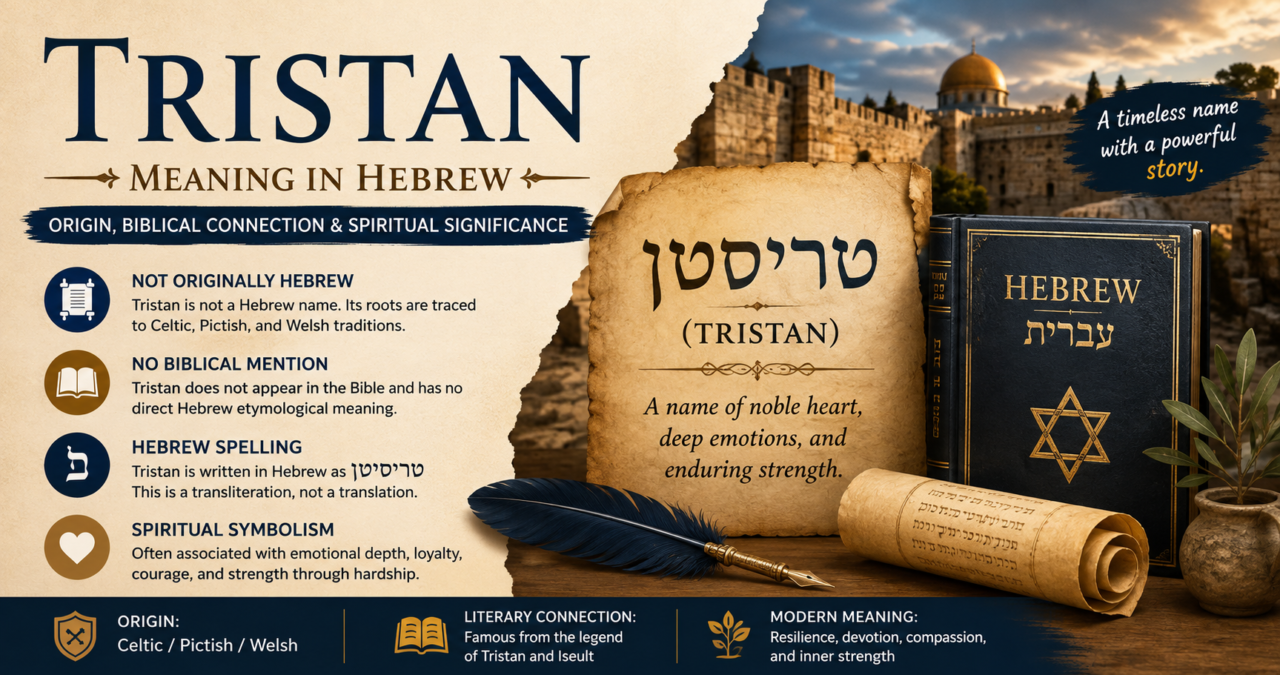

The search for Tristan meaning in Hebrew often comes from people who want to understand whether the name has a Hebrew origin, a biblical connection, or a deeper spiritual meaning. Tristan is a familiar and attractive name in English-speaking countries, but its history is more complicated than simply assigning it a Hebrew definition. In fact, Tristan is generally traced to Celtic, Pictish, Welsh, and medieval European naming traditions rather than ancient Hebrew.
That distinction is important because a name can have a meaningful spiritual interpretation without actually being a Hebrew or biblical name. When people investigate Tristan meaning in Hebrew, they may encounter websites claiming that Tristan directly means sorrow, strength, or something similar in Hebrew. A more accurate explanation is that the sorrowful association comes from the name’s medieval European history and its connection with the Old French word triste, meaning sad.
Is Tristan a Hebrew Name?
Tristan is not originally a Hebrew name. Its earliest history is generally connected with older Celtic or Pictish forms such as Drust or Drustan, with the Welsh form appearing as Drystan or Trystan. The name became especially famous through medieval French romances about Tristan and Iseult, where the spelling and interpretation of the name developed further.
This means there is no original Hebrew root from which the name Tristan developed. If someone asks for the literal Tristan meaning in Hebrew, the most accurate answer is that Tristan does not possess a native Hebrew etymological meaning. It can be written phonetically in Hebrew, but writing a foreign name in Hebrew letters does not transform its origin or give it a new Hebrew definition.
What Is the Actual Origin of the Name Tristan?
The history of Tristan reaches back much farther than its popularity in modern English. Name researchers commonly connect it with the old Pictish name Drustan, which is considered a diminutive form related to Drust. Welsh forms such as Drystan are also associated with the same historical naming family.
The exact original meaning is not completely certain, which is why responsible sources describe the etymology cautiously. Some historical interpretations connect the Celtic or Brittonic root with ideas such as noise, tumult, or disturbance. A French linguistic influence later encouraged an association with triste, meaning sad or sorrowful.
Why Is Tristan Associated With Sorrow?
The association between Tristan and sadness became especially strong because of medieval literature. The famous story of Tristan and Iseult is a tragic romance filled with love, conflict, separation, loyalty, and loss. When the name entered French literary tradition, it was influenced by the Old French word triste, which means sad.
Because of this literary connection, people sometimes assume that sorrow was always the literal meaning of the name. That is too simple. The sorrowful interpretation is better understood as a later association rather than proof that Tristan originally came from a Hebrew word meaning sadness. This distinction makes the discussion of Tristan meaning in Hebrew much clearer.
Tristan Meaning in Hebrew: The Direct Answer
The direct answer is straightforward: Tristan has no original Hebrew meaning. It is not derived from biblical Hebrew, and it does not appear as a traditional Hebrew personal name in the Bible. Its linguistic background belongs primarily to Celtic, Pictish, Welsh, and medieval European traditions.
When Hebrew speakers use the name, it can be transliterated as טריסטן. This simply represents the pronunciation of Tristan using Hebrew characters. It is similar to how many international names are written in another alphabet. The spelling changes, but the historical origin of the name does not.
How Is Tristan Written in Hebrew?
A common Hebrew transliteration of Tristan is טריסטן. Transliteration is different from translation. Translation attempts to communicate a word’s meaning in another language, while transliteration attempts to reproduce the sound of a name using another writing system.
This difference matters when researching Tristan meaning in Hebrew. Seeing טריסטן written in Hebrew does not mean that Tristan has suddenly acquired a Hebrew definition. It is simply a practical way for Hebrew readers to pronounce and recognize the foreign name.
Does Tristan Appear in the Bible?
Tristan is not a biblical name and does not appear as a named biblical character in the Old Testament or New Testament. Its development took place in European traditions rather than in the ancient Hebrew naming environment associated with the Hebrew Bible.
This does not make the name unsuitable for people who value the Bible or Christian traditions. Many names used by Christians today come from languages and cultures outside the Bible. A person can choose a name because of its sound, history, family meaning, or personal symbolism without claiming that the name itself is biblical.
Is There a Hebrew Word Similar to the Meaning of Tristan?
Although Tristan does not come from Hebrew, Hebrew contains several words associated with sorrow, grief, mourning, pain, and related emotional experiences. These words can help explain why people searching for Tristan meaning in Hebrew sometimes encounter Hebrew concepts connected with sadness.
For example, biblical Hebrew has vocabulary expressing grief and sorrow, but those words are not etymological sources for Tristan. In other words, a Hebrew word may describe a concept associated with the later interpretation of Tristan, while having no historical relationship to the name itself. That distinction should always be kept clear when discussing name meanings.
The Spiritual Meaning People Associate With Tristan
Even though Tristan is not Hebrew, people can still give it a thoughtful spiritual interpretation. Because the name became associated with sorrow through medieval literature, some modern interpretations connect it with emotional depth, endurance, compassion, loyalty, and the ability to continue through difficult circumstances.
This is a symbolic interpretation rather than a translation. When someone searches for Tristan meaning in Hebrew, they may actually be looking for the spiritual idea behind the name rather than a strict linguistic definition. In that context, Tristan can represent a person who experiences hardship but develops strength, empathy, and courage through it.
Tristan and the Idea of Strength Through Hardship
One of the most interesting ways to understand Tristan is through the contrast between sorrow and strength. A name associated with a tragic literary character does not necessarily have to be viewed negatively. Human history is full of examples where difficult experiences produce patience, wisdom, compassion, and emotional maturity.
That makes Tristan an appealing name for people who prefer meanings with depth. Instead of interpreting sorrow as weakness, the name can symbolically suggest someone who understands pain and remains resilient. This broader interpretation is particularly useful for people exploring Tristan meaning in Hebrew from a spiritual rather than purely linguistic perspective.
Tristan and Christian Name Traditions
Tristan is not a biblical name, but that does not prevent Christian families from using it. Christian naming traditions have never been limited exclusively to names that appear in Scripture. Over time, names from Greek, Latin, Germanic, Celtic, French, and other cultures have become common among Christian communities.
For someone interested in Tristan meaning in Hebrew because of Christian beliefs, the key point is honesty about the name’s history. It is better to say that Tristan is a non-biblical European name that can be given a positive spiritual interpretation than to claim that it is secretly a Hebrew biblical name.
The Story of Tristan and Iseult
The medieval story of Tristan and Iseult played a major role in making the name famous. Tristan is portrayed as a noble and courageous figure whose life becomes connected with Iseult through a complicated and tragic love story. The tale has been retold in different forms across European literature.
This literary history helps explain why the name has such a distinctive emotional character. Tristan is not simply a modern name chosen for its pleasant sound. It carries centuries of associations involving courage, loyalty, love, conflict, sacrifice, and sadness. Those associations are part of what makes the name interesting to people researching Tristan meaning in Hebrew and its broader significance.
What Does Tristan Symbolize?
Symbolically, Tristan can represent several qualities. Courage is one because the legendary Tristan is frequently portrayed as a brave warrior and heroic figure. Loyalty is another because relationships and personal commitments are central to the medieval story surrounding the name.
The name can also symbolize emotional depth. Its association with sadness gives it a reflective quality that differs from names whose traditional meanings focus only on happiness, victory, wealth, or physical strength. For some families, that emotional complexity makes Tristan feel sophisticated and memorable.
Is Tristan a Good Name for a Baby?
Whether Tristan is a good baby name ultimately depends on personal taste, family background, and the meaning parents want to attach to it. From a linguistic perspective, it is an established international name with a long history and recognizable pronunciation.
Parents who are specifically looking for a Hebrew biblical name should understand that Tristan does not meet that description. However, parents who simply want a name with historical depth, literary connections, and a strong yet gentle sound may find Tristan appealing. Knowing the facts behind Tristan meaning in Hebrew allows families to make that decision without relying on inaccurate claims.
Does Tristan Mean Sadness in Hebrew?
No. Tristan does not literally mean sadness in Hebrew. The connection with sadness comes primarily from its medieval association with Old French triste, while the deeper origin of the name is generally connected with older Celtic or Pictish forms.
This is one of the most important points to remember. Saying that Tristan is associated with sadness is reasonable when discussing its European literary history. Saying that Hebrew defines Tristan as sadness would be misleading. A careful explanation separates the original language from later cultural associations.
Is There a Hebrew Equivalent of Tristan?
There is no exact Hebrew equivalent of Tristan because equivalent names are not always created by translating literal meanings. A Hebrew-speaking family could use the original name in transliterated form, such as טריסטן, or choose a completely different Hebrew name based on the quality or concept they admire.
For example, someone attracted to Tristan because of its association with courage might choose a Hebrew name traditionally connected with strength or bravery. Someone attracted to its emotional symbolism might instead choose a Hebrew name associated with comfort, hope, or joy. These would be conceptual alternatives, not translations of Tristan.
Tristan Meaning in Hebrew and Personal Interpretation
Names often become more meaningful through the lives of the people who carry them. A person named Tristan does not have to be defined by the tragic elements of medieval literature. The name can become associated with kindness, intelligence, loyalty, creativity, courage, or any other quality that the individual develops.
This is especially relevant when considering Tristan meaning in Hebrew from a modern spiritual perspective. The absence of a Hebrew origin does not prevent a family from giving the name personal significance. What matters is that the family understands the historical facts and then decides what the name represents to them.
Common Misunderstandings About Tristan
One common misunderstanding is that every popular name must have a direct biblical or Hebrew meaning. That is not true. Names travel between languages and cultures, and many modern names have histories that stretch across several regions.
Another misunderstanding is that a name’s modern interpretation must be identical to its original meaning. Tristan demonstrates why that assumption can be problematic. Its early Celtic or Pictish background and its later French literary association are not exactly the same. The name’s meaning developed alongside its cultural history.
Why People Search for Tristan Meaning in Hebrew
People may search for Tristan meaning in Hebrew for several reasons. Some may be expecting a baby and want to understand the name before choosing it. Others may have encountered the name in the Bible, a religious discussion, a family tree, or a spiritual naming website and want to know whether the information is accurate.
The search can also come from curiosity about whether Tristan has a hidden biblical connection. The answer is useful precisely because it clears up the difference between historical etymology and spiritual interpretation. Tristan has an interesting story, but that story begins in European linguistic traditions rather than biblical Hebrew.
The Positive Side of Tristan’s Meaning
Although sadness is one of the best-known associations attached to Tristan, the name does not have to carry a negative message. A more balanced interpretation sees emotional difficulty as part of the human experience and focuses on what can emerge from it.
From that perspective, Tristan can symbolize resilience, loyalty, courage, compassion, and emotional awareness. These qualities are not literal translations of the name into Hebrew. They are modern symbolic values inspired by the name’s history and literary tradition.
Final Thoughts on Tristan Meaning in Hebrew
The most accurate explanation of Tristan meaning in Hebrew is that Tristan is not originally a Hebrew name and does not have a native Hebrew etymology. Its roots are generally associated with Celtic, Pictish, and Welsh naming traditions, while its later form and sorrowful association were strongly influenced by medieval French literature and the word triste, meaning sad.
When written in Hebrew as טריסטן, the name is simply transliterated into Hebrew characters. It does not become a biblical name or acquire a new Hebrew definition. At the same time, people can reasonably give Tristan a personal or spiritual interpretation centered on courage, loyalty, emotional depth, perseverance, and strength through difficult experiences.
So, if you are researching Tristan meaning in Hebrew because you are considering the name for a child, studying its history, or looking for its biblical connection, the best answer is both simple and nuanced: Tristan is not Hebrew, but it has a rich European history and can carry meaningful symbolism today. Understanding that distinction makes the name even more interesting and helps separate genuine etymology from popular but unsupported interpretations.
Conclusion
The story behind Tristan meaning in Hebrew is a good reminder that names can cross languages and cultures without keeping the same interpretation throughout history. Tristan is not a Hebrew or biblical name, and there is no authentic Hebrew definition that can be presented as its original meaning. Its roots are instead connected with older Celtic, Pictish, and Welsh traditions, while medieval French literature helped create its famous association with sadness.
For modern families, however, a name can mean more than its dictionary definition. Tristan can represent courage in difficult moments, loyalty to the people we love, emotional depth, and the strength to move forward after hardship. Those ideas are symbolic rather than Hebrew etymology, but they can still make the name personally meaningful.
If your main goal is to find a strictly Hebrew biblical name, Tristan is not the right classification. If your goal is to find a distinctive name with European history, literary depth, and an emotional character, Tristan has plenty to offer. Understanding the real Tristan meaning in Hebrew makes the choice clearer, more informed, and more meaningful.
Frequently Asked Questions About Tristan Meaning in Hebrew
Is Tristan a Hebrew name?
No, Tristan is not originally a Hebrew name. Its roots are generally traced to Celtic, Pictish, and Welsh traditions, with its familiar form becoming prominent through medieval French literature.
What does Tristan mean in Hebrew?
There is no direct Hebrew meaning of Tristan because the name does not originate from Hebrew. It can be transliterated into Hebrew as טריסטן, but that is a representation of its sound rather than a Hebrew translation.
Is Tristan mentioned in the Bible?
No. Tristan is not found as a personal name in the Old Testament or New Testament. Its history developed outside the biblical naming tradition.
Does Tristan mean sadness?
Tristan became associated with sadness because medieval French traditions connected the name with triste, an Old French word meaning sad. However, this should not be confused with a literal Hebrew meaning.
Is Tristan a good spiritual name?
It can be, depending on the meaning a family gives it. Although it is not biblical or Hebrew, Tristan can symbolically represent courage, loyalty, emotional depth, resilience, and perseverance. These are personal or spiritual associations rather than the name’s literal Hebrew definition.
Is Tristan a Christian name?
Tristan is not a biblical Christian name, but it is widely usable within Christian communities. Its European literary and cultural history gives it a long-standing place in Western naming traditions.
What is the Hebrew spelling of Tristan?
A common Hebrew transliteration is טריסטן. This spelling reproduces the sound of the name in Hebrew characters rather than translating its meaning.
What is the real origin of Tristan?
The name is generally connected with older Pictish and Celtic forms such as Drust and Drustan, with Welsh forms including Drystan. Its medieval popularity was strongly influenced by the Tristan and Iseult romances.
YOU MAY READ ALSO
Tristan Meaning in Hebrew: Origin, Biblical & Spiritual Meaning