
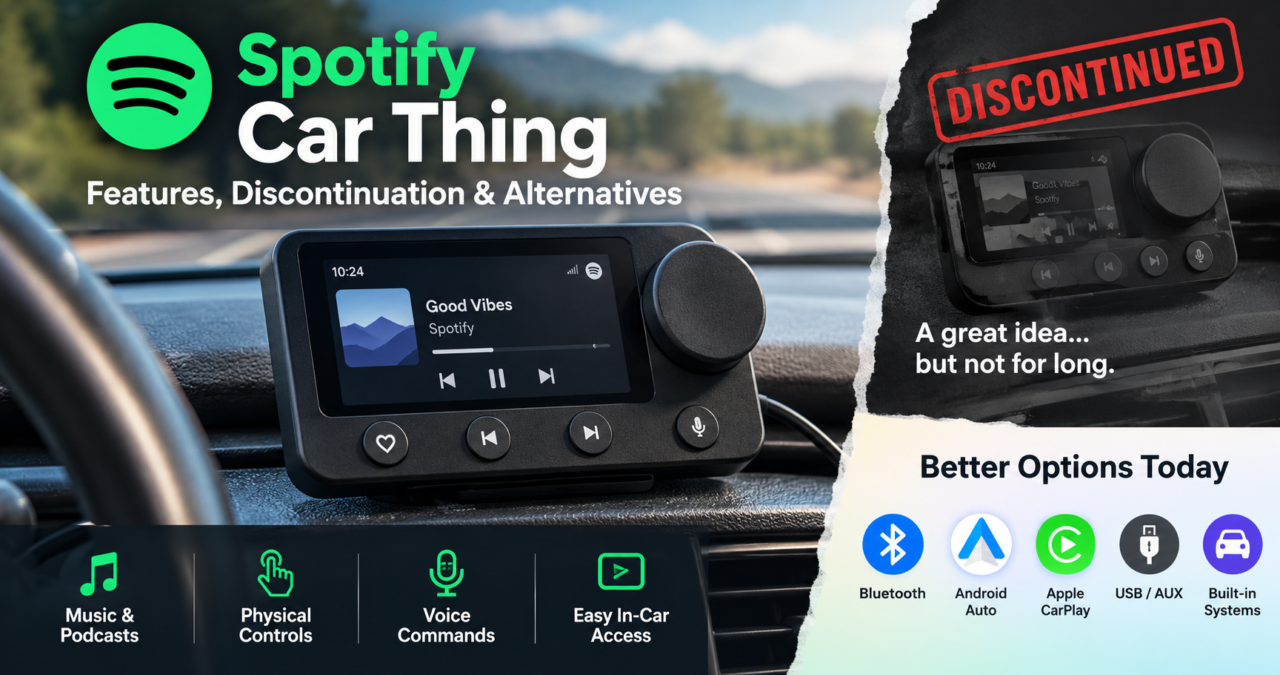

If you have ever searched for Spotify Car Thing, you have probably noticed that the story behind this little device is surprisingly interesting. It was designed to make listening to Spotify in the car easier, especially for people driving older vehicles without modern infotainment systems. Instead of constantly reaching for a phone, drivers could use a dedicated screen, physical controls, preset buttons, and voice commands to manage music and podcasts.
The idea sounded simple, but it solved a genuine problem. Many cars still have perfectly usable speakers and Bluetooth or AUX connections but lack a convenient touchscreen interface. Spotify Car Thing attempted to fill that gap without requiring drivers to replace their entire stereo system. Spotify officially launched the device in the United States after testing it with selected users, presenting it as a smart player built specifically for the road.
There is, however, an important part of the story that anyone researching Spotify Car Thing should know today: the device is no longer operational. Spotify eventually discontinued the hardware and later disabled the remaining units. That makes Spotify Car Thing less of a current car accessory and more of an interesting example of a hardware experiment that did not become a long-term product.
What Was Spotify Car Thing?
Spotify Car Thing was a compact dedicated music-control device created by Spotify for use inside a vehicle. It connected with a user’s smartphone and car audio system, allowing Spotify content to be controlled through a small dashboard-mounted interface. The product was particularly aimed at drivers whose vehicles lacked modern touchscreen infotainment systems.
Rather than trying to replace an entire car stereo, Spotify Car Thing focused on doing one job well: making Spotify easier to control while driving. Spotify described the product as a way to bring its music and podcast catalog to a wider variety of vehicles. Users could interact with the device through its touchscreen, physical controls, preset buttons, and voice commands.
The concept was actually tested before it became a consumer product. Spotify first explored the idea as a voice-controlled device for selected users, using the experiment to understand how people interacted with audio while driving. The company made it clear during the early testing period that the purpose was to learn about listening behavior rather than immediately build a large hardware business.
That experimental background is important because it explains why Spotify Car Thing was somewhat different from traditional consumer electronics. Spotify was not simply trying to create another touchscreen. It was testing whether dedicated hardware could make its audio service more useful in a particular environment.
Why Did Spotify Create Car Thing?
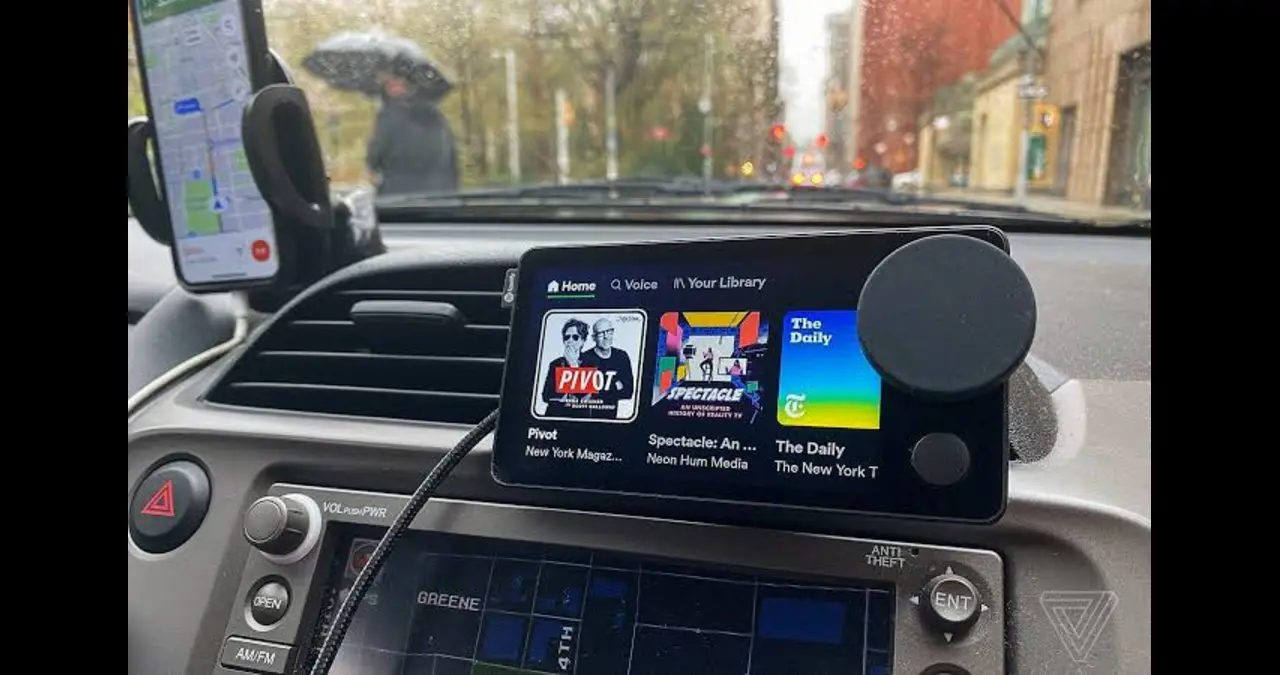
The main reason behind Spotify Car Thing was convenience. Smartphones can obviously play Spotify, but using a phone while driving is not always ideal. A small dedicated interface could make common actions easier, such as changing a playlist, selecting a podcast, skipping a track, or accessing a favorite.
Older vehicles were especially relevant to the concept. A car might have excellent speakers but still have an outdated dashboard system. Replacing the stereo could be expensive or inconvenient, while a small accessory offered a simpler alternative. Spotify saw an opportunity to bring a more modern listening interface to those vehicles.
The company also wanted to understand how people actually listen while driving. Spotify had already observed a huge amount of driving-related listening activity on its platform. The Spotify Car Thing experiment therefore gave the company an opportunity to study the relationship between its service, drivers, voice commands, physical controls, and vehicle environments.
This explains why the product was never really positioned as a competitor to a full infotainment system. Spotify said its goal was to make its audio experience available more seamlessly wherever people listened, rather than compete directly with the larger systems built into modern vehicles.
How Did Spotify Car Thing Work?
The basic setup for Spotify Car Thing was relatively straightforward. The device relied on a smartphone for connectivity and used the car’s audio system to deliver the sound. In other words, it was not a completely independent music player that replaced your phone.
Once connected, the device provided a dedicated interface for Spotify. The screen showed information about what was playing, while the physical dial could be used to browse and select content. There were also preset buttons that gave users quick access to favorite content. This combination was one of the most distinctive aspects of Spotify Car Thing.
Voice control was another major feature. Users could say “Hey Spotify” and ask for songs, albums, artists, playlists, stations, or podcasts. Spotify designed the device with multiple microphones to help it understand voice requests even when music was playing or the vehicle was moving with the windows open.
That mixture of physical and voice interaction made Spotify Car Thing different from simply opening the Spotify app on a phone. Instead of depending entirely on touch controls, drivers had several ways to interact with their audio.
The Physical Design of Spotify Car Thing
One of the most memorable things about Spotify Car Thing was its physical design. The device was small enough to sit naturally within a car’s dashboard area, and its design clearly focused on quick interaction rather than trying to look like a full tablet.
The large physical dial was particularly useful. Users could rotate it to browse through content and press it to make selections. Physical controls can be valuable inside a vehicle because they provide tactile feedback without requiring a driver to stare at a touchscreen for every action.
The device also included a display that showed what was playing and provided access to Spotify content. Preset buttons made it possible to reach favorite playlists, podcasts, and other frequently used content more quickly. Spotify’s approach was essentially to combine the convenience of a modern interface with controls that were easy to locate physically.
Spotify Car Thing and Voice Control
Voice control was a major part of the Spotify Car Thing experience. Spotify wanted drivers to be able to request audio without spending too much time interacting with the screen.
A simple voice command could be used to request a particular song or artist. Users could also ask for playlists and podcasts, making the experience feel closer to having a dedicated audio assistant in the vehicle.
Spotify later expanded the functionality of the device with additional software features. The company introduced options for answering phone calls, controlling other media, adding tracks to a queue, and using voice commands to request personalized music based on a mood or activity.
These updates showed that Spotify was trying to make Spotify Car Thing more than a basic remote control. The company was gradually turning it into a more flexible interface for entertainment inside the car.
What Made Spotify Car Thing Different?
There were already several ways to use Spotify in a vehicle, so the existence of Spotify Car Thing needed a clear reason to exist. Its strongest advantage was simplicity.
A phone can do almost everything Spotify Car Thing could do, but a phone is also a multipurpose device. Notifications, messages, maps, calls, and other applications can compete for attention. A dedicated Spotify interface removed much of that distraction from the equation.
The physical controls were another advantage. Turning a dial or pressing a dedicated button can feel more natural in a car than attempting to navigate multiple menus on a small phone screen.
However, this advantage became less convincing as Android Auto, Apple CarPlay, and built-in infotainment systems became more common. Spotify itself currently recommends several ways to use the service in vehicles, including Bluetooth, AUX or USB connections, Android Auto, Apple CarPlay, Spotify Connect, and compatible built-in car systems.
Why Was Spotify Car Thing Discontinued?
The biggest question surrounding Spotify Car Thing is why Spotify eventually abandoned it.
Spotify stopped producing the device after its initial consumer release. Contemporary reporting and Spotify’s own announcements pointed to factors including product demand and supply-chain issues. The company had entered the hardware market experimentally, but Spotify Car Thing did not generate enough demand to justify continuing production.
There was also a growing competitive problem. Modern vehicles increasingly offered built-in infotainment systems, while older cars could often use Android Auto or Apple CarPlay through aftermarket upgrades. That made it harder for a Spotify-only screen to stand out.
The timing was also difficult. Consumers already had smartphones that could provide Spotify, navigation, calls, and many other functions from one device. Asking users to purchase an additional piece of hardware for primarily Spotify-related control was a harder proposition.
When Did Spotify Car Thing Stop Working?
The final chapter of Spotify Car Thing was more significant than simply stopping production. Spotify announced that the remaining devices would eventually stop operating.
The shutdown date was December ninth, twenty twenty-four. On that date, Spotify disabled the remaining Spotify Car Thing devices, meaning owners could no longer use them as originally intended for Spotify playback. TechCrunch confirmed the shutdown after users began seeing messages that their devices were no longer operational.
This decision generated considerable frustration among owners because the physical hardware still existed. A device that looked perfectly usable could no longer provide its original Spotify functionality.
Spotify subsequently advised owners to reset their devices and dispose of them through appropriate electronic-waste channels. The company also provided a refund process for eligible customers, with the reported deadline for contacting customer service being January fourteenth, twenty twenty-five.
Why Were People Upset About Spotify Car Thing?
The reaction to the shutdown was understandable. People had purchased Spotify Car Thing as a physical product, and some expected the hardware to remain useful for a reasonable period.
The controversy was not simply about Spotify ending production. Companies discontinue products all the time. The more difficult issue was that existing devices were eventually made nonfunctional rather than simply being left with whatever functionality they already had.
This raised a broader conversation about connected hardware and digital ownership. When a device depends on a company’s online service, purchasing the physical hardware does not necessarily guarantee that the software powering it will remain available indefinitely.
The Spotify Car Thing situation therefore became an example of the risks associated with cloud-dependent electronics. A product can be physically intact while becoming unusable because the service it depends on has been switched off.
Can You Still Buy Spotify Car Thing?
If you see Spotify Car Thing being advertised today, you should be very cautious. The original device is discontinued and the official Spotify service that powered it has been shut down.
A second-hand listing might show a clean-looking unit with its screen, dial, and buttons working physically. That does not mean it can perform its original function. The important distinction is between hardware that powers on and a device that can actually connect to Spotify and provide the intended experience.
Some enthusiasts have experimented with repurposing old Spotify Car Thing units. Reports have documented projects attempting to give the hardware new uses outside Spotify’s original ecosystem. These projects are interesting for technically minded users, but they are not the same thing as restoring the official Spotify experience.
Can Spotify Car Thing Be Used With Another Music Service?
Officially, Spotify Car Thing was designed around Spotify, so it was never intended to become a universal music player supporting every streaming service.
That is one of the product’s biggest limitations today. Even if someone manages to modify the hardware, doing so can require technical knowledge, custom software, and experimentation. It is not a straightforward plug-and-play replacement for the original service.
For most people, there are easier alternatives. A smartphone connected through Bluetooth, Android Auto, Apple CarPlay, USB, or AUX can provide access to Spotify without relying on obsolete dedicated hardware. Spotify’s current support documentation lists these connection methods as ways to use Spotify in a vehicle.
Best Alternatives to Spotify Car Thing
If what attracted you to Spotify Car Thing was the idea of convenient in-car music control, you do not necessarily need a dedicated Spotify device.
Android Auto and Apple CarPlay are probably the most practical modern solutions for compatible vehicles. They allow supported apps to appear through the car’s infotainment interface while keeping your phone connected. Spotify also supports Bluetooth and wired connections, depending on the vehicle and audio system.
For an older car without a modern infotainment system, a Bluetooth connection can be enough if the stereo supports it. An AUX connection can also work with the appropriate hardware. These options may not provide the same dedicated physical interface that Spotify Car Thing offered, but they are much easier to maintain.
Some vehicles also include Spotify directly in their infotainment systems. In those situations, there is little reason to add another dedicated Spotify screen.
What Spotify Car Thing Taught About Smart Hardware
The story of Spotify Car Thing offers a useful lesson for the broader technology industry. Hardware products connected to online services have two lifespans: the physical lifespan of the device and the commercial lifespan of the software behind it.
A gadget may remain physically functional for years, but if the company stops maintaining the required servers or software, its usefulness can disappear almost instantly. This is increasingly important as smart speakers, cameras, watches, vehicles, and other connected products depend on cloud services.
Spotify Car Thing also demonstrates how difficult it can be for a specialized accessory to compete against platforms that are already built into phones and vehicles. A product can have a clever interface and still struggle if consumers do not feel that they need another device.
In this case, the concept itself was not necessarily bad. The problem was the market around it. Drivers already had phones, Bluetooth, increasingly capable car systems, Android Auto, and Apple CarPlay. That left a relatively narrow audience for a dedicated Spotify screen.
Is Spotify Car Thing Still Relevant?
Even though Spotify Car Thing no longer works officially, the idea behind it remains relevant.
Drivers still want simple controls, quick access to playlists, voice commands, podcast controls, and interfaces that reduce unnecessary phone interaction. Those needs did not disappear when the device was discontinued.
What changed is how those needs are being addressed. Instead of a Spotify-only accessory, modern drivers are increasingly using integrated infotainment systems and smartphone platforms.
That is why the story of Spotify Car Thing is worth remembering. It was not simply a failed gadget. It represented an experiment in how a streaming company could move beyond the phone and create a specialized experience for a particular environment.
The Legacy of Spotify Car Thing
The legacy of Spotify Car Thing is a little unusual. It was a small product with a relatively short commercial life, but it generated a lot of discussion about connected hardware, digital ownership, and the future of in-car entertainment.
Spotify originally presented the device as an exploration into better listening experiences. The company learned from the product, added new capabilities, and eventually decided that hardware was not the direction it wanted to continue pursuing.
For users, the biggest takeaway is simple: dedicated hardware can offer an excellent experience when the supporting ecosystem is healthy, but consumers should also consider how dependent that hardware is on the company behind it.
The Spotify Car Thing story demonstrates both sides of modern technology. On one side, specialized hardware can make everyday tasks easier and more enjoyable. On the other, cloud-dependent devices can become obsolete even when the physical hardware itself remains intact.
Final Thoughts on Spotify Car Thing
Spotify Car Thing was an interesting attempt to solve a real problem: making Spotify easier and safer to control inside vehicles that lacked modern infotainment systems. Its physical dial, preset buttons, touchscreen, microphones, and voice commands gave it a personality that ordinary phone-based listening did not have.
However, the product entered a market where smartphones and car infotainment systems were already becoming increasingly capable. Spotify eventually stopped producing the device and later disabled the remaining units, officially ending the product’s original purpose.
Today, anyone searching for Spotify Car Thing should understand that it is no longer an officially supported Spotify accessory. Modern alternatives such as Bluetooth, Android Auto, Apple CarPlay, AUX, USB, and built-in Spotify integrations offer much more practical ways to listen in a car.
Still, Spotify Car Thing remains an interesting piece of technology history. It showed that people wanted a dedicated, simple interface for in-car audio, even if the particular hardware solution did not last. For technology enthusiasts, it is also a reminder that buying connected hardware means depending not only on the device itself, but also on the service and company supporting it.
Conclusion
Spotify Car Thing was an interesting attempt to make in-car listening simpler, more convenient, and more focused on Spotify. With its dedicated display, physical controls, preset buttons, and voice features, the device offered something different from simply using a smartphone. It was especially useful for drivers with older vehicles that did not have modern infotainment systems.
However, the technology landscape changed quickly. As smartphones, Android Auto, Apple CarPlay, Bluetooth, and built-in vehicle entertainment systems became more capable, the need for a dedicated Spotify device became much smaller. Spotify eventually discontinued Car Thing and shut down the service that powered the remaining devices, bringing the product to an end.
Even though Spotify Car Thing is no longer an active product, its story remains valuable. It shows how difficult it can be for connected hardware to succeed when consumers already have convenient alternatives. For people interested in technology, Spotify Car Thing is also a good reminder that the future of a smart device depends not only on its physical hardware but also on the software and services supporting it.
Frequently Asked Questions
What was Spotify Car Thing?
Spotify Car Thing was a dedicated in-car music-control device designed by Spotify. It connected with a smartphone and vehicle audio system and provided a screen, physical controls, preset buttons, and voice commands for controlling Spotify.
Does Spotify Car Thing still work?
No. The official Spotify Car Thing service was shut down in December twenty twenty-four, and the remaining devices were disabled.
Why did Spotify discontinue Car Thing?
Spotify ended the product because it did not achieve sufficient demand and because of supply-chain challenges. Competition from existing smartphone and vehicle technologies also made a dedicated Spotify accessory difficult to justify.
Can I buy a used Spotify Car Thing?
You may encounter used units through resale marketplaces, but buying one for normal Spotify use is not recommended because the official service has been discontinued. A used unit may be interesting to collectors or hobbyists interested in hardware experimentation.
What can I use instead of Spotify Car Thing?
Current alternatives include Bluetooth, AUX or USB connections, Android Auto, Apple CarPlay, Spotify Connect, and compatible built-in vehicle infotainment systems.
YOU MAY READ ALSO