
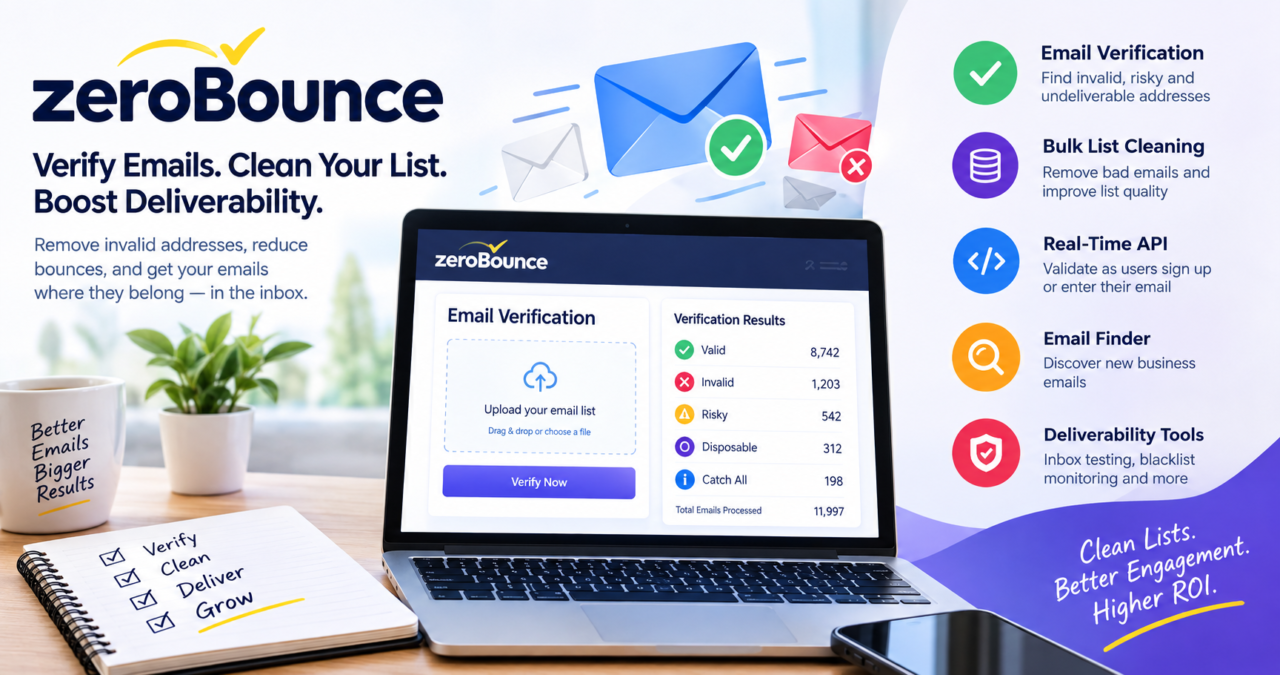

Email marketing looks simple on the surface: collect addresses, create a campaign, press send, and wait for results. In reality, the quality of an email list can make or break an entire campaign. A list filled with outdated, misspelled, inactive, disposable, or risky addresses can lead to bounced emails, lower engagement, and damage to your sender reputation. This is where ZeroBounce becomes useful.
ZeroBounce is an email verification and deliverability platform designed to help businesses check email addresses before sending campaigns. It can identify problematic addresses and provide additional tools for improving the chances that legitimate messages reach real inboxes. The platform also supports bulk list cleaning, API-based verification, email finding, inbox testing, blacklist monitoring, and other deliverability features.
For marketers, sales teams, agencies, developers, and businesses that depend heavily on email, ZeroBounce offers a practical way to make email databases cleaner and more useful. Instead of treating every email address as equally valuable, the platform helps users understand which contacts are safer to reach and which ones may create delivery problems.
What Is ZeroBounce?
ZeroBounce is an email validation service that checks whether email addresses are likely to be deliverable. The basic idea is straightforward: before you send a large campaign, you can analyze your list and remove addresses that could result in hard bounces or other unwanted outcomes.
The service is particularly useful when an email database has been collected over a long period. People change jobs, abandon old inboxes, switch providers, use temporary addresses, or enter incorrect information into forms. Even a carefully managed list can gradually become outdated. Email verification gives marketers a way to identify these problems before launching another campaign.
One reason ZeroBounce has attracted attention is that it combines email validation with broader deliverability tools. Instead of focusing only on whether an address follows the correct format, the platform looks at different characteristics of an address and can classify results into various categories. Its documentation says the technology can identify more than thirty email statuses and sub-statuses, including categories such as catch-all, abuse, and spam traps.
Why Email Verification Matters
Sending messages to invalid addresses creates more than a small inconvenience. When a campaign generates too many hard bounces, email providers can begin to view the sender less favorably. Over time, that can make it harder for future campaigns to reach the inbox.
This is why list hygiene has become an important part of email marketing. A smaller list containing genuinely reachable contacts can be more valuable than a huge database filled with questionable addresses. ZeroBounce is designed around this idea, helping businesses clean their lists before those addresses become a problem.
Email verification can also make campaign reporting easier to understand. If a company sends messages to thousands of addresses and a significant portion of them are invalid, the resulting engagement statistics may not accurately reflect the quality of the campaign. Cleaning the list first provides a better foundation for measuring opens, clicks, conversions, and other marketing outcomes.
How ZeroBounce Email Verification Works
The basic workflow behind ZeroBounce is easy to understand. A user provides an email list, and the platform processes the addresses to determine their status. The results can then be used to separate safer contacts from addresses that may need to be removed or reviewed.
Businesses can use the platform for individual checks as well as larger list-cleaning projects. According to its documentation, users can also use its API for real-time validation, which can be useful when a company wants to check addresses as people enter them into registration forms or other online systems.
The real advantage comes from making verification part of an ongoing workflow rather than treating it as a one-time task. New contacts constantly enter databases, while existing contacts can become inactive. Regular verification helps businesses keep their lists healthier over time.
Key Features of ZeroBounce
One of the strongest aspects of ZeroBounce is that it is more than a basic email checker. The platform brings several tools together under one ecosystem, allowing users to work on different parts of their email deliverability strategy.
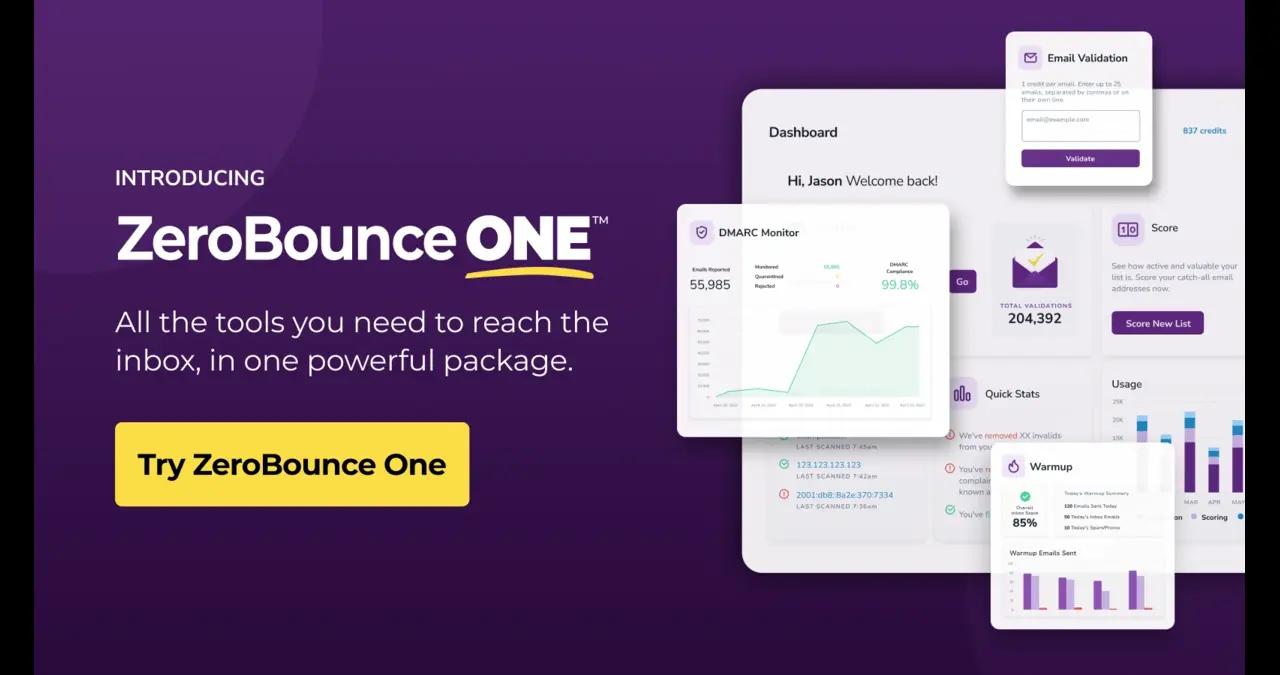
Its core email validation service is designed to identify addresses that may be unsafe or undeliverable. Beyond that, the platform offers tools such as Email Finder, AI-based scoring, inbox placement testing, email server testing, blacklist monitoring, and DMARC monitoring depending on the plan.
This broader approach can be helpful for organizations that want a single platform instead of managing several separate services. It also means that ZeroBounce can be useful to different types of users, from a small marketer cleaning a mailing list to a development team integrating validation into a website.
Bulk Email List Cleaning
Bulk list cleaning is one of the most obvious reasons a business might use ZeroBounce. Imagine a company has collected email addresses for years through newsletters, downloads, purchases, events, and online forms. The database may look impressive, but not every address will still be active.
Uploading the list for verification can help identify problematic records before a major campaign. Removing invalid contacts can reduce unnecessary bounces and help the business focus its marketing efforts on addresses that are more likely to receive messages.
This can be particularly useful for businesses that send newsletters or promotional campaigns regularly. Instead of waiting for bounce reports after every campaign, marketers can make verification part of their preparation process.
Real-Time Email Verification API
For websites and applications, manual list cleaning is not always enough. New email addresses can be created every minute through registration pages, contact forms, lead-generation campaigns, and checkout processes.
The ZeroBounce API allows developers to integrate email verification into applications and workflows. Its documentation explains that the API can be used with websites, applications, and landing pages, allowing email addresses to be validated automatically.
This approach can prevent some bad addresses from entering a database in the first place. For example, if a visitor accidentally enters an invalid address into a signup form, a verification workflow can flag the problem before that contact becomes part of a larger marketing list.
ZeroBounce and Email Deliverability
Email validation and email deliverability are closely connected, but they are not exactly the same thing. Validation focuses heavily on the quality and status of addresses, while deliverability involves the broader process of getting legitimate messages into inboxes.
ZeroBounce addresses both areas through a collection of tools designed to provide more insight into email performance. Its platform includes inbox placement testing, email server testing, blacklist monitoring, and other deliverability-oriented features.
That distinction is important because even a perfectly valid email address does not automatically guarantee that a message will land in the primary inbox. Sender reputation, authentication, content, engagement, domain reputation, and provider-specific filtering can all influence delivery.
Accuracy and Reliability
Accuracy is one of the biggest considerations when choosing an email verification service. An inaccurate result can cause a company to remove a legitimate customer or keep a risky address.
ZeroBounce currently publishes a verification accuracy guarantee and reports a minimum guarantee of ninety-nine point six percent for many addresses, with different terms for certain major providers.
The company also published a self-conducted benchmark in twenty twenty-six comparing its service with several competing email verification tools. In that benchmark, ZeroBounce reported an overall accuracy result of ninety-eight point zero two percent across a difficult test set. Because the study was conducted by ZeroBounce itself, it is best viewed as company-reported performance data rather than an independent industry certification.
That distinction matters. Businesses should consider published benchmarks alongside their own testing, list characteristics, and campaign results rather than assuming that any advertised accuracy percentage will apply identically to every database.
Security and Data Protection
Email lists can contain valuable business information, so security is an important consideration when uploading them to an external platform. Companies may be handling customer contacts, leads, subscribers, and other sensitive business data.
According to its documentation, ZeroBounce says uploaded and downloaded files are encrypted and that customer data is not stored permanently in a database. The company also states that users can delete validation results and that data left on the platform is automatically deleted after a specified period.
The company also reports SOC two Type Two certification, which relates to controls around areas including security, availability, processing integrity, confidentiality, and privacy.
For organizations evaluating an email verification provider, these claims should still be reviewed against the company’s current security documentation, contractual requirements, and internal compliance policies.
ZeroBounce Integrations
Modern marketing systems rarely operate independently. A company may use a CRM, email marketing platform, customer database, landing-page builder, spreadsheet, and automation software at the same time.
ZeroBounce supports integrations and APIs designed to connect email verification with other systems. Its integration documentation lists connections involving platforms such as HubSpot, Salesforce, Mailchimp, Klaviyo, WordPress, WooCommerce, Zapier, and other services.
This flexibility is useful because businesses can incorporate verification into existing workflows rather than manually exporting and importing lists every time. For technical teams, API access can also provide greater control over when and how validation occurs.
ZeroBounce Email Finder
Email verification and email discovery are different tasks. Verification generally starts with an existing email address and evaluates its status. Email finding begins with information such as a person’s name and company domain and attempts to identify a possible business email address.
ZeroBounce offers an Email Finder feature as part of its broader platform. The company says its Email Finder does not scrape the internet for email addresses and instead uses domain patterns and real-time verification to test potential addresses.
This can be useful for sales teams and lead-generation professionals who need to build prospect lists. However, users should always follow applicable privacy laws, marketing regulations, platform rules, and responsible outreach practices when collecting and contacting business leads.
ZeroBounce Pricing
Pricing is an important factor when deciding whether an email verification platform makes sense for a business. ZeroBounce uses a volume-based model, meaning the effective cost per verification can decrease as the number of credits purchased increases.
The company currently lists pay-as-you-go verification pricing starting with a minimum purchase of two thousand credits, while its ZeroBounce ONE subscription includes a monthly allocation of verification and other deliverability-related credits. The current published subscription price is ninety-nine dollars per month, with an annual billing option listed at a lower monthly equivalent.
The platform also offers a free account with a limited number of monthly validation credits. Pricing and included features can change, so businesses should check the current official pricing page before making a purchasing decision.
Is ZeroBounce Worth Using?
Whether ZeroBounce is worth using depends heavily on how important email is to a business. Someone sending occasional personal messages probably has little reason to pay for professional email validation. A company sending large campaigns, managing a sizable lead database, or collecting thousands of new contacts is in a very different situation.
For professional marketers, the value is not simply about removing invalid addresses. Better list quality can contribute to cleaner campaign reporting, fewer bounces, and more efficient use of marketing resources. The platform’s additional deliverability tools may also be useful for organizations that want more visibility into their email infrastructure.
The best way to evaluate ZeroBounce is to test it with a representative sample of your own data. That gives a business a more realistic idea of how the platform performs with its particular audience, industries, domains, and database quality.
Who Should Use ZeroBounce?
ZeroBounce can be particularly useful for email marketers, sales teams, agencies, online businesses, SaaS companies, publishers, and organizations that depend on email communication.
Marketing teams can use it to clean subscriber databases before campaigns. Sales teams can use its verification and finding tools as part of prospecting workflows. Developers can connect the API to websites and applications to validate addresses in real time.
Smaller businesses can also benefit if email is an important part of customer acquisition. The question is less about company size and more about how much the organization depends on maintaining a healthy email database.
Best Practices When Using ZeroBounce
Using an email verifier does not replace good list-building practices. Businesses should still collect addresses through legitimate methods, avoid purchasing questionable databases, and give subscribers clear choices about receiving communications.
It is also a good idea to verify lists periodically instead of relying on a single cleanup forever. Email addresses change over time, and a database that was healthy several months ago may contain new inactive or risky contacts today.
Another smart practice is to combine verification with proper email authentication and deliverability monitoring. SPF, DKIM, DMARC, sender reputation, engagement, and content quality all contribute to the overall health of an email program. ZeroBounce can support some parts of this process, but no verification service can replace a complete deliverability strategy.
Final Thoughts on ZeroBounce
ZeroBounce has developed into more than a simple email address checker. Its combination of email validation, list cleaning, API access, Email Finder, scoring, inbox testing, blacklist monitoring, and other deliverability features makes it a broader email performance platform.
The biggest benefit is the ability to make email databases more reliable before valuable campaigns are sent. Instead of treating every address as equally trustworthy, businesses can use verification data to make better decisions about which contacts deserve attention.
At the same time, users should keep expectations realistic. A verified email address does not guarantee engagement, a reply, or inbox placement. Successful email marketing still depends on permission-based list building, strong content, authentication, reputation management, and consistent engagement.
For businesses where email plays a major role in sales or marketing, ZeroBounce can be a useful part of that larger strategy. Its current feature set and pricing make it worth considering, particularly for organizations that need both bulk verification and ongoing deliverability support. The smartest approach is to test the service with your own data, review its current policies and pricing, and then decide whether it fits your workflow.
Conclusion
ZeroBounce is a useful solution for businesses that want to maintain a cleaner, healthier, and more reliable email database. By checking email addresses before campaigns are sent, businesses can identify invalid or risky contacts and reduce unnecessary delivery problems. This can make email marketing more efficient while also helping marketers understand their audience and campaign data more clearly.
Another advantage of ZeroBounce is that it goes beyond basic email verification. Its broader collection of deliverability tools, API capabilities, email finding features, and monitoring options can support businesses at different stages of their email marketing workflow. Whether you manage a small subscriber list or a large customer database, maintaining good email hygiene can make a meaningful difference.
However, ZeroBounce should be viewed as one part of a larger email marketing strategy. Verification alone cannot guarantee that every message will reach the inbox or that recipients will engage with your content. Good list-building practices, relevant content, proper authentication, and consistent monitoring are still essential.
Overall, ZeroBounce can be a practical choice for marketers, sales teams, agencies, developers, and organizations that depend on email communication. Keeping your database accurate and regularly maintained can help create more dependable campaigns and a stronger foundation for long-term email marketing success.
Frequently Asked Questions
What is ZeroBounce?
ZeroBounce is an email verification and deliverability platform that helps businesses check email addresses and maintain cleaner mailing lists. It can identify potentially invalid, risky, or undeliverable addresses before they are used in email campaigns.
How does ZeroBounce help email marketers?
ZeroBounce can help email marketers improve list hygiene by identifying problematic addresses before campaigns are sent. Cleaner lists can reduce unnecessary bounces and provide marketers with more meaningful campaign performance data.
Can ZeroBounce verify email addresses in real time?
Yes. ZeroBounce provides an API that developers can integrate into websites, applications, signup forms, and other systems. This allows email addresses to be checked automatically as they are collected.
Is ZeroBounce useful for small businesses?
Yes. Small businesses can use ZeroBounce when maintaining a healthy email database is important to their marketing or sales activities. The value depends more on email volume and business needs than on company size.
Does ZeroBounce guarantee inbox delivery?
No. Email verification can help identify problematic addresses, but it cannot guarantee inbox placement. Factors such as sender reputation, email authentication, content quality, recipient engagement, and the policies of individual email providers also affect deliverability.
YOU MAY READ ALSO
ZeroBounce: Complete Guide to Email Verification & Deliverability