
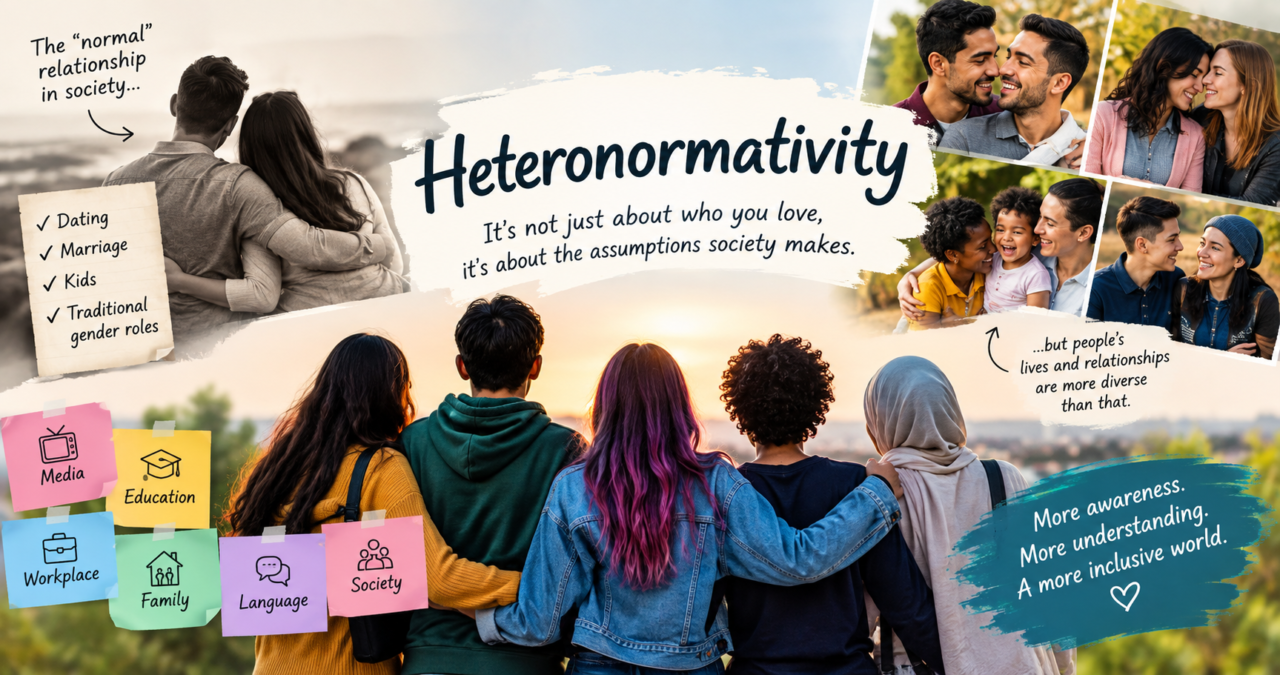

Heteronormativity is a term used to describe the social assumption that heterosexuality is the normal, natural, or expected way for people to experience romantic and sexual relationships. It can influence everyday conversations, family expectations, entertainment, education, workplaces, and even the language people use when talking about relationships. Often, heteronormativity is so deeply woven into ordinary life that people may not notice it until they encounter an experience that does not fit the expected pattern.
Understanding heteronormativity is not simply about learning a new social term. It is about recognizing how certain expectations become treated as universal even though people’s identities, relationships, and experiences are much more diverse. Looking closely at heteronormativity can help explain why some assumptions feel ordinary while other experiences are treated as unusual or require additional explanation.
What Does Heteronormativity Mean?
Heteronormativity refers to a cultural framework in which heterosexual relationships are treated as the standard or default. It can create the impression that people are naturally expected to be attracted to people of another gender, form traditionally structured romantic relationships, marry, and build families according to familiar social patterns. These expectations do not necessarily come from one individual or organization. Instead, they can develop through repeated social habits.
The concept also includes assumptions about gender roles within relationships. For example, a culture may expect men and women to behave in particular ways when dating, marrying, raising children, or managing a household. When those expectations are presented as universal, they can make other forms of identity and relationships seem less visible or less legitimate.
Heteronormativity does not mean that every heterosexual person personally believes that other identities are wrong. A person can have a heterosexual relationship while also supporting people with different identities and relationship structures. The concept focuses primarily on broader social expectations and systems rather than judging individuals based solely on their personal relationships.
How Heteronormativity Appears in Everyday Life
Heteronormativity can appear in surprisingly ordinary situations. Someone might ask a young woman whether she has a boyfriend without considering that she could have a girlfriend, be attracted to multiple genders, or have no interest in dating. A teacher might describe future family life using only a husband-and-wife example. A workplace conversation might casually assume that every employee has an opposite-gender partner.
These examples may seem minor, but repeated assumptions can communicate a larger message about what society considers normal. When people constantly hear the same relationship pattern presented as the default, individuals whose lives differ from that pattern may feel pressure to explain themselves or remain silent.
Entertainment can also reinforce these expectations. Movies, television programs, advertisements, books, and social media frequently present heterosexual romance as the central model of love. Representation has become more diverse in many places, but traditional patterns remain common enough that they can continue shaping people’s ideas about relationships.
Why Heteronormativity Develops
Heteronormativity has developed through a combination of historical, cultural, religious, legal, economic, and social influences. Different societies have had different understandings of relationships and sexuality, but many modern institutions have historically been organized around heterosexual marriage and traditional family structures.
Law and public policy have also played important roles. When institutions define family benefits, marriage rights, inheritance, parenting expectations, or household responsibilities around heterosexual couples, those structures can reinforce the idea that heterosexual relationships are the standard.
Education and socialization contribute as well. Children learn about relationships from parents, teachers, television, books, friends, and their surrounding communities. If most of the examples they encounter involve heterosexual couples, they may naturally absorb the idea that heterosexuality is expected. This is one reason social assumptions can continue across generations even when individuals do not consciously intend to exclude anyone.
Heteronormativity and Gender Expectations

Heteronormativity is closely connected to ideas about gender. Traditional heterosexual relationship models often assign specific roles to men and women. Men may be expected to initiate romantic relationships, provide financially, or appear emotionally strong, while women may be expected to prioritize caregiving, appearance, or family responsibilities.
These expectations can affect heterosexual people as well as people with other sexual orientations. A man who does not fit traditional ideas of masculinity may be criticized for appearing too emotional or passive. A woman who does not want traditional relationship roles may be described as unusual or difficult.
This demonstrates why heteronormativity is broader than simply assuming someone is heterosexual. It can also establish a larger social script about how men and women are supposed to behave around one another. People who do not follow that script may experience pressure even when their relationships are heterosexual.
Examples of Heteronormativity in Family Life
Family conversations can provide some of the clearest examples of heteronormativity. Parents and relatives may casually ask someone when they will find a husband or wife, have children, or settle down. Such questions may be intended as friendly conversation, but they can carry assumptions about what someone’s future should look like.
A family may also treat heterosexual relationships differently from other relationships. For example, relatives might immediately accept a son’s girlfriend as a potential future family member while asking more questions when another family member introduces a same-gender partner. The difference may come from unfamiliarity rather than deliberate hostility, but the underlying expectation can still be significant.
Recognizing these patterns does not require families to abandon traditions. It simply means allowing individuals to define their own relationships and futures. Families can maintain strong connections while becoming more open to different ways of building a meaningful life.
Heteronormativity in Education
Schools and universities can unintentionally reinforce heteronormativity through curriculum, examples, language, and classroom culture. Lessons about relationships may consistently use heterosexual couples as examples. Health education may focus heavily on heterosexual dating or reproduction without providing an inclusive discussion of different identities and experiences.
Language matters here because students notice what is included and what is missing. If a classroom routinely assumes that every student will eventually have an opposite-gender spouse, some students may feel that their experiences are invisible.
Creating a more inclusive educational environment does not require every lesson to focus on sexuality. Simple changes can make a difference, such as using broader language when discussing relationships and avoiding assumptions about students’ identities. The goal is to make education informative without suggesting that one type of person or relationship is the universal standard.
Heteronormativity in the Workplace
Workplaces can also contain subtle forms of heteronormativity. Employees often discuss spouses, dating, weddings, children, and family plans during casual conversations. When coworkers automatically use opposite-gender terms for someone’s potential partner, they may unintentionally make assumptions about that person’s identity.
Workplace forms and policies can reinforce these patterns as well. If benefits, family leave, social events, or employee resources are designed around a narrow understanding of family, some workers may feel less recognized.
An inclusive workplace does not mean that people must constantly discuss sexuality. Instead, it means creating an environment where employees are not expected to fit a particular relationship model. Respectful language, fair policies, and awareness of different family structures can reduce unnecessary barriers.
The Difference Between Heteronormativity and Heterosexuality
It is important to distinguish heteronormativity from heterosexuality. Heterosexuality describes sexual or romantic attraction between people of different genders. Heteronormativity describes a social expectation that heterosexuality is the normal or preferred standard.
This distinction matters because criticizing heteronormativity is not the same as criticizing heterosexual people. A heterosexual person can recognize social assumptions and support a more inclusive culture. Likewise, someone can be in a heterosexual relationship without personally reinforcing restrictive ideas about gender or relationships.
The focus is therefore on expectations rather than individual identity. Understanding this difference makes conversations about heteronormativity more productive because it prevents the discussion from becoming an unfair judgment of people based solely on whom they love.
How Heteronormativity Can Affect LGBTQ+ People
Heteronormativity can create challenges for LGBTQ+ people because it may make their identities feel less visible or less expected. When heterosexuality is consistently treated as the default, people with different sexual orientations may repeatedly find themselves deciding whether to disclose personal information or correct incorrect assumptions.
These experiences can range from small everyday inconveniences to serious social consequences. Someone may avoid mentioning their partner at work, hesitate to discuss their personal life with relatives, or feel uncomfortable in environments where heterosexual relationships are constantly presented as the only normal option.
The impact varies from person to person. Not everyone experiences heteronormativity in the same way, and individuals may respond differently depending on family relationships, culture, workplace environment, community attitudes, and personal circumstances.
Heteronormativity and Media Representation
Media has a powerful role in shaping social expectations because stories influence what audiences imagine as normal. For many years, mainstream entertainment frequently presented heterosexual romance as the central or expected form of romantic storytelling.
When other identities are absent or portrayed only as unusual characters, audiences can receive a narrow picture of human relationships. Representation can challenge this pattern by showing diverse people as complete characters whose lives are not defined exclusively by their sexuality.
Better representation does not simply mean adding different characters to a story. It can also involve presenting relationships naturally, allowing characters to have different personalities, ambitions, families, conflicts, and experiences. This helps move representation away from the idea that people outside traditional norms exist only to provide a social lesson.
Heteronormativity and Language
Language is one of the simplest ways people can notice heteronormativity in daily life. Words such as husband, wife, boyfriend, and girlfriend are perfectly appropriate when they accurately describe someone’s relationship, but assuming those terms before knowing someone’s situation can create unnecessary limitations.
More neutral language can sometimes be useful. Asking whether someone has a partner instead of automatically asking about a boyfriend or girlfriend leaves room for the person to describe their relationship themselves.
This does not mean people need to become afraid of ordinary language. The purpose is simply to avoid treating assumptions as facts. Being thoughtful about language can make conversations more comfortable without making them complicated.
Is Heteronormativity Always Intentional?
Heteronormativity is often unintentional. People may repeat assumptions they learned from family, school, media, religion, culture, or previous social experiences without consciously deciding that those assumptions are correct.
For example, a person might ask a male friend whether he has a girlfriend because that is the question they have always heard. The question may not come from prejudice. However, the assumption behind it still reflects a broader cultural expectation.
Understanding this distinction is useful because it allows people to recognize patterns without turning every mistake into a personal attack. Someone can make an assumption, learn from the situation, and change their language or behavior. Social awareness grows through that kind of reflection.
How People Can Challenge Heteronormativity
Challenging heteronormativity can begin with something as simple as questioning automatic assumptions. Instead of assuming that everyone wants marriage, children, or a traditional family, people can recognize that different individuals have different goals.
Another useful approach is to listen when someone describes their identity or relationship. Rather than comparing their experience with a familiar social script, give them room to explain themselves in their own words.
Organizations can also review policies and communication. Inclusive forms, broader definitions of family, respectful workplace practices, and diverse educational materials can reduce unnecessary assumptions. These changes do not require abandoning traditional families. They simply make space for people whose lives do not follow one traditional pattern.
Why Awareness of Heteronormativity Matters
Awareness of heteronormativity matters because social expectations can influence people even when nobody explicitly tells them what to do. Individuals may feel pressure to behave according to a particular relationship model because that model is constantly presented as the expected path through life.
Recognizing these pressures gives people an opportunity to think critically about where their expectations come from. Someone might discover that a belief they considered personal was actually influenced by family traditions, media, social expectations, or cultural habits.
That kind of awareness can encourage greater freedom. People can still choose heterosexual marriage, traditional family life, or conventional gender roles if those choices genuinely suit them. The important point is that those choices should not be treated as the only legitimate options.
Common Misunderstandings About Heteronormativity
One common misunderstanding is that heteronormativity means every heterosexual person is prejudiced. That is not accurate. The term describes a social framework and pattern of assumptions rather than a simple label for individual attitudes.
Another misunderstanding is that recognizing heteronormativity requires rejecting heterosexual relationships. It does not. People can value heterosexual relationships while also recognizing that relationships come in many forms.
A further misunderstanding is that the concept only concerns sexuality. In reality, heteronormativity can overlap with expectations about gender, marriage, family, parenting, masculinity, femininity, and social roles. Looking at these connections provides a much clearer understanding of how the concept operates.
Heteronormativity in Modern Society
Modern society has become more aware of diverse identities and relationships, and many communities have become more accepting of experiences that were previously ignored or stigmatized. Social media has also allowed people to connect with others who share experiences that may not be visible in their local communities.
At the same time, older expectations have not disappeared everywhere. People can encounter very different attitudes depending on their families, schools, workplaces, communities, and cultural environments.
This is why conversations about heteronormativity remain relevant. Social change does not happen uniformly. Some environments become inclusive quickly, while others continue to rely heavily on traditional assumptions. Understanding the concept can help people recognize those differences without assuming that every person’s experience is identical.
How Heteronormativity Can Be Discussed Respectfully
Conversations about heteronormativity are most useful when they focus on understanding rather than accusation. People may have different levels of knowledge about sexuality, relationships, and social expectations. A respectful discussion can create room for questions and learning.
It is also helpful to remember that people have individual experiences. One person may find certain assumptions harmless, while another may find the same assumptions uncomfortable because of their personal history. Neither reaction automatically represents everyone’s experience.
The goal of discussing heteronormativity is not to force everyone into the same worldview. Instead, it is to encourage awareness of assumptions and give people greater freedom to describe their lives accurately.
The Broader Meaning of Heteronormativity
At its core, heteronormativity is about the power of social expectations. When one type of relationship is repeatedly presented as ordinary, other possibilities can become less visible. That does not mean every traditional relationship is harmful. It means society should be careful about confusing familiarity with universality.
People build relationships and families in many different ways. Some marry, some do not. Some have children, some do not. Some form long-term partnerships, while others prefer different forms of companionship. A healthy society can recognize this variety without demanding that everyone follow one predetermined path.
Understanding heteronormativity therefore provides a useful way to examine everyday assumptions. It encourages people to ask whether something is genuinely universal or simply familiar because culture has repeated it for generations.
Conclusion
Heteronormativity describes the social expectation that heterosexuality and traditionally structured heterosexual relationships are the normal or default way of living. It can appear in family conversations, schools, workplaces, media, language, laws, and everyday interactions. Often, these patterns are subtle and unintentional, which makes awareness especially important.
Understanding heteronormativity does not require rejecting heterosexual relationships or traditional families. Instead, it encourages people to recognize that no single relationship model represents everyone’s life. By questioning automatic assumptions, using inclusive language, listening to people’s experiences, and creating room for different identities and families, society can become more respectful and flexible.
Ultimately, learning about heteronormativity is about understanding how social expectations shape the way people see themselves and others. When those expectations are recognized rather than treated as universal truths, individuals have more space to define their relationships, identities, and futures on their own terms.
Frequently Asked Questions
What is heteronormativity?
Heteronormativity is a social framework that treats heterosexuality and traditionally structured heterosexual relationships as normal, expected, or default. It can influence ideas about dating, marriage, family, gender roles, and everyday communication.
Is heteronormativity the same as heterosexuality?
No. Heterosexuality refers to attraction between people of different genders, while heteronormativity refers to social expectations that position heterosexuality as the standard or default.
Can heterosexual people experience heteronormativity?
Yes. Heteronormativity can affect everyone because it includes expectations about gender roles, marriage, family, and relationship behavior. Heterosexual people may also feel pressure to follow traditional relationship patterns.
Where can heteronormativity be found?
Heteronormativity can appear in families, education, workplaces, entertainment, advertising, social conversations, forms, policies, and everyday language. It may be obvious in some situations and very subtle in others.
Why is understanding heteronormativity important?
Understanding heteronormativity helps people recognize assumptions that may otherwise go unnoticed. It can encourage more inclusive communication and make it easier for individuals to express their identities and relationships without being forced into a predetermined social model.
YOU MAY READ ALSO